I have posted some about pawpaws (Asimina triloba) before, but I haven't said a lot about them in detail. Pawpaws grow wild throughout much of the eastern, southern, and central U.S. Efforts to improve pawpaws and develop the species into a productive, domesticated, orchard crop have been made for decades. Some efforts have been much more organized and successful than others. If you are interested in pawpaws you should check out the work going on at:
Kentucky State: https://kysu.edu/academics/cafsss/pawpaw/
Neil Peterson's: https://www.petersonpawpaws.com/
My experience with pawpaws is that, here in Missouri, you have one of two things:
1) Wild pawpaws - relatively low production, smaller fruits, sometimes have 'off' flavors, some years they make no fruit, are relatively abundant in some areas, but are relatively scarce in others, generally un-maintained and growing in wooded areas (especially in the under story with partial to heavy shade).
2) Pawpaws grown as an orchard crop - often grafted trees, usually uniformly spaced in rows, can require some level of maintenance (but often less than other fruit crops in Missouri). Almost always in full (or almost full) sunlight.
There are also combinations of these. For example, you could graft wild pawpaw trees to cultivars that produce more and larger fruit. You could also graft young wild pawpaw trees so that they will produce fruit sooner. There are obstacles to attempting to turn wild pawpaw groves into orchards, but interestingly there is a history of doing this in Missouri with other crops, notably pecans. Missouri has many wild pecan groves where other trees species have been cut over the years to encourage the pecan trees to produce more nuts, and in some of these wild pecan groves now contain trees that growers have grafted that are more productive and/or disease resistant.
There are many differences between pecan and pawpaw trees, but the premise is the same. Find areas where there are wild pawpaw trees, thin out some of the other tree species, leave the pawpaw trees, and manage them for production. The advantage to this method is basically the same as it is for creating pecan groves, you can get production faster and it is possible to keep establishment costs lower. The trade-off is you may not have an ideal site, and you may never see the maximum production potential you would see if you picked and ideal site and planted the orchard there, spaced the trees at an ideal spacing, grafted only the most productive cultivars, etc.
I have done both of these at my farm and combinations of them. I have planted organized orchards of young pawpaw trees, I have unmanaged wild pawpaw stands, and I have managed and grafted wild stands of pawpaw trees. Basically this is the same thing I have with pecans as well (although the pawpaws take up much less space than pecan trees, which is great).
Here is a video of me talking about a small area I have grafted some cultivars onto wild pawpaw rootstocks.
Short pawpaw video
There are two things that make a lot of sense to me about pawpaw cultivation.
1) Low maintenance - For a FRUIT crop in Missouri. Pawpaws are more flexible in their site requirements than many other fruits. This does not mean you will get high yields on all sites (you will not). This does not mean you won't have problems on some sites, but it does mean that you can successfully grow pawpaws in areas you would never be able to grow a peach tree for example, or a grape vine (ex. in partial shade).
2) Profitability - If you have a market to sell your pawpaws, it can be quite lucrative. If you have no market to sell your pawpaws, then they probably won't be very lucrative. This concept is not unique to pawpaws, but it means that you need to plan at least a little before you are holding the fruit in your hand wondering what to do with it. There is often not a huge supply of pawpaws available (especially fresh) so if you can get them to people who want them you have a little more flexibility in your pricing (you are more of a price maker than a price taker, which is a good situation to be in).
Since costs of production can be relatively low, and prices attained for quality fruit can be high, the POTENTIAL exists to actually see some profit.
In the future I will make another post about some pawpaw cultivars I like and why I like them. There are quite a few out there right now. I will say 'Sunflower' is one of the cultivars I really like, but a full discussion of pawpaw cultivars is a post for another day.
Sunday, June 7, 2020

Saturday, January 11, 2020
Orchard Groundcovers and Legumes
Orchard Groundcovers
There are a lot of different options out there for orchard ground preparation, and options for plants to establish in young and mature orchards. A lot of the information out there for establishing young pecan orchards isn't really geared towards really low input approaches.
For example, in some of my orchards (pictured below), conventional tillage before planting to 'prepare' a seedbed for ground cover establishment was not really a good option in my opinion for a few reasons:
1) Cost in terms of $$. When you start talking establishing acres of grass and legumes from bare ground seed costs start climbing quickly.
2) Cost in terms of soil erosion. Most of the trees are on extremely erodible ground, and I know these areas have lost enough topsoil in the past that I didn't want to lose more, so very minimal soil disturbance was a MUST
3) I already had some really desirable plant species growing in some of these areas and I would rather not kill them.
I could have went with some different approaches using herbicides. If I had wanted to use herbicides on this site, my best bet probably would have been to go from tree to tree and spray a wide circle of herbicide all around them. In my opinion spraying strips of herbicides within the entire row would not have been a good idea since some of these rows of wild pecan seedlings run downhill, so it is likely I would have suffered some erosion from that approach. Some areas are a fine silt loam and others are a sandy loam, and they have a tendency to erode the instant water moves over bare soil. So when thinking about orchard preparation in your own orchards pay attention to your unique conditions, because it is very likely some of the recommendations on 'best practices' for some locations may not work well for yours.
Working on so much highly erodible soil, I always try to prioritize protecting the soil. I can replace a lot of things, trees, others plants, etc, but I can't replace soil once it is gone. If I lose an inch of topsoil through carelessness, that is more soil than is going to be created in my entire lifetime.
In the end, what I chose to do in terms of ground cover establishment was extremely minimal and involved no herbicide or tillage.
So what did I end up doing in terms of orchard prep?
I thought about what I would need in the future for these trees. I wanted a ground cover that I could establish with minimal inputs (no tillage, no herbicide), and one that was going to work for me to help the trees meet the high demands for nutrients they will have in the future when they are trying to grow AND produce a nut crop. Since I knew these were two of the important things to me, I decided to look into legumes and combinations of legumes I could easily establish and that were most likely to persist (and/or set large amounts of seed) and continue to fix nitrogen into the soil for years to come. I decided to establish a mix of legumes, mostly through frost seeding (if you aren't familiar with this look it up). I bought bulk quantities of red clover, common white clover, ladino clover, and korean lespedeza and frost seeded them (after I inoculated them with the appropriate inoculant) for two winters over the entire area of the pecan orchards. The results have been excellent (see picture below).
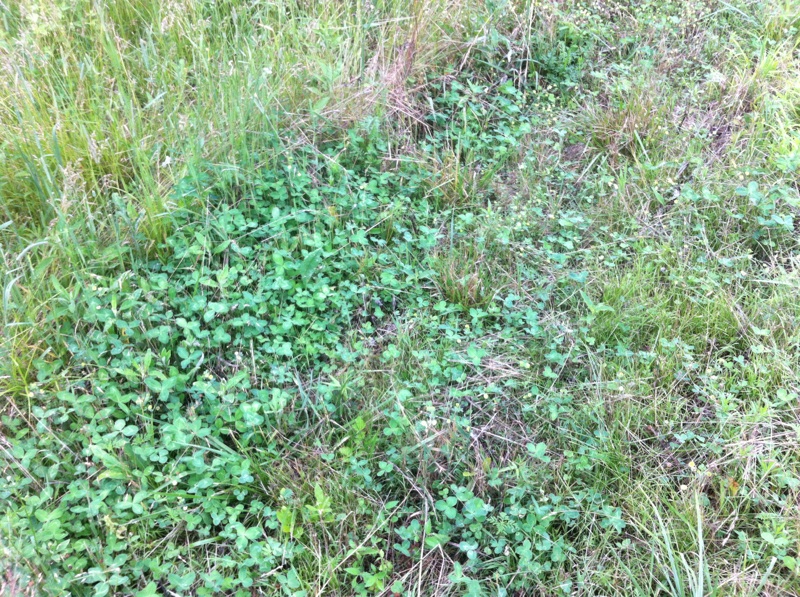
ABOVE: Red clover and white clover are dense, the mowing early in establishment really helped.

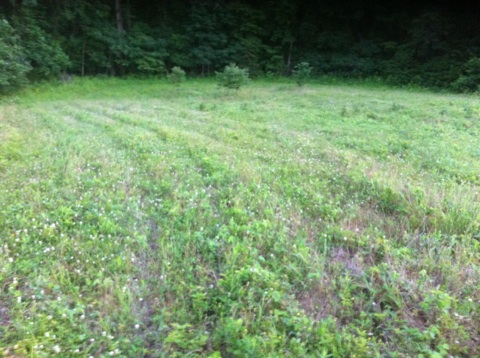 ABOVE: You can see the prolific flowering of white clover across this field. Two years of frost seeding different types of white clover (among others) over this areas has really paid off. White clover seed especially is incredibly cheap per lb for the amount of seed you get. It also has a very low seeding rate because there are so many seeds per lb. It is also very effective at fixing nitrogen. It was a no brainer to include it in my mixtures. Note that frost seeding with clover was incredibly inexpensive for me. My total seed costs per year average out to something like $5 or so per acre, and my labor (it took a few hours to walk the whole pecan orchard using a hand broadcast seeder, but it worked very well for the extremely low seeding rate needed for things like white clover). I do not see any way to get that amount of nitrogen on these fields more efficiently and for such a long amount of time than what these plants are doing right now.
BELOW: This is a close up of what is going on. There are a lot of other plant species that are in the orchards as well, and that is fine with me. At this stage in the orchard I am not harvesting nuts from the ground so I don't need an orchard floor that is clipped very short to facilitate nut harvest. I can let the clovers, other legumes, and native plants grow relatively tall then mow them down a few times during the year. I try to time my mowing so that I am letting some of the clover and other select species go to seed if it is a species I want to see more of.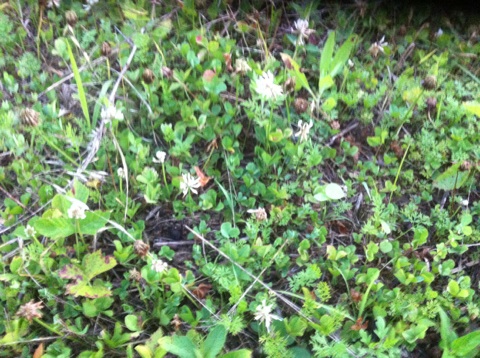

The moist winter of 2018-2019 and moist spring of 2019, coupled with regular mowing to control some of the grasses and other plants in the orchards, have allowed large numbers of the legumes to establish rapidly and make satisfactory growth this year. I have dug some samples of these legumes to check for nodulation on their roots (an indicator of below ground nitrogen fixation) and I am finding a large percentage of them with nodules. I am also favoring various native legumes including large areas of partridge pea (see picture below, really an attractive looking plant). When I mow I leave the large areas of partridge pea standing as it flowers, and allow it to go to seed. I have dug multiple partridge pea plants and I am seeing nodulation on their roots as well.
BELOW: Partridge pea on the edge of a field

BELOW: Nodules on a white clover plant

Saturday, August 31, 2019
Getting Pecan trees into nut production quickly
Wild seedling pecan sprouts versus planting your own
If you have seen my previous posts on pecan you know I am a big fan of finding vigorous native pecan sprouts that are located on good pecan sites and grafting them whenever possible, versus planting them and spending more time and money in tree establishment. It's not always the case that good seedling sprouts magically appear in perfect rows and work out with my plans, but when they do I absolutely choose to work with them, versus spending the extra time, energy, and money to plant and establish the trees myself. In fact, if within he first year of planting seedling pecans I see a wild pecan sprout come up near my tree I will often leave it and if it outgrows my planted tree that year, or the next, I will cut down my planted pecan (as long as it is also a seedling) and begin to care for the wild sprout.
This year I took a few pictures of good examples of why it makes more sense to favor wild seedling sprouts like this. The odds are favorable that they already have a fairly extensive root system and are often capable of fantastic growth with very, very, minimal care and inputs. This isn't to say your 1st year planted seedling tree couldn't make similar growth, but I have never seen a 1 year old pecan tree planted in the field that competed favorably in a low input environment with an already established wild seedling pecan.
Here are a couple examples.
BELOW:
This tree was grafted in SP 2018. It was a relatively short sprout that had even had the top browsed off by deer before I grafted it. It was roughly 1 inch in diameter at about 2 feet from the ground and was relatively short (likely from being continuously eaten by deer) probably around 3 feet tall. I grafted it at about that 2- 2.5 foot mark (which is lower than I would normally graft) and caged it to prevent the deer from eating the graft. This is the tree in the summer of 2019. It is now approximately 10 feet tall, the very top of the tree is just off the top of the picture. The wooden post on the right in the picture is about 5 feet out of the ground. In 1 year and a half this tree has made 7 feet of growth (from the original 3 foot tall tree to the current 10 foot tall tree). Last summer was also a fairly severe drought in this area that killed quite a few seedling pecan trees I had tried to establish, but instead of dying this tree thrived.
BELOW:
Another seedling that made relatively good growth this year. It is now approximately 9 feet tall.
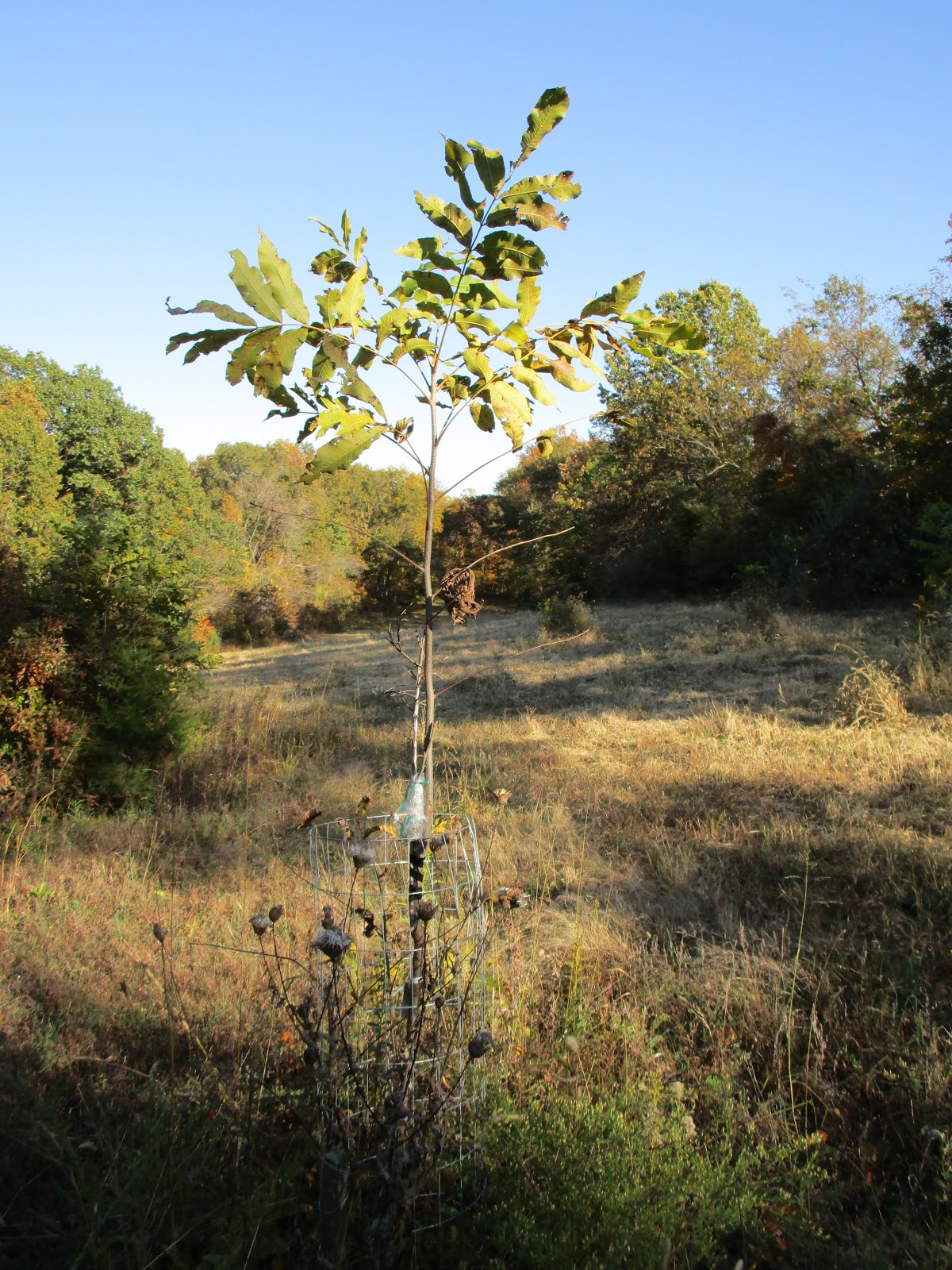
BELOW:
I grafted this pecan at about the height I like to graft them when possible. It is grafted at around my chest height and it was grafted in SP 2019. It has a little competition for light from some nearby trees, so it is really trying to grow up. In the future most of those trees it is competing with will be thinned. This tree is 9 feet tall now as Summer 2019 wraps up, so over the spring and summer of 2019 it has done really well. We were blessed with heavy rainfall in 2019 so even the newly planted seedling pecans have done well, but still the already established wild pecan sprouts have done even better.

BELOW:
This is likely one of the parents of many of the seedling pecan sprouts in my upland pecan orchards. It is one of the large mature pecan trees on the edges of the woods and fields where my young trees are growing. Throughout the forested areas near my orchards there are large (50+ years old) mature pecans as well as younger pecans (1-20 years old) near any forest openings.

Tuesday, June 25, 2019
Identifying Young Wild Pecan trees at your Orchard Site
In some of my previous posts I have talked about the advantages of grafting wild pecan trees that are already established (saves you time, saves you money, you get pecan nuts sooner, etc.). As I have said before, if you already have some larger pecan trees around your property, it is very likely that squirrels and mother nature have planted more pecans for you than you can imagine. If you want to let them grow, arguably, the most important thing you will have to do is not kill them. Whether they are in an area you mow, brush hog, or in an area where you have animals grazing, you will probably have to do something to protect them when they are very young.
The easiest thing I have found is to follow these few steps:
1) Identify the young pecan tree - often this is easiest in the late spring-early summer. First year pecan trees will be sprouting at this time and it is very easy to miss them and mow them over.
2) Drive a wooden stake in the ground next to the tree once it is identified. Make sure this stake will be taller than any of the vegetation around it. You want this to be tall enough that you will be able to see it above any grass.
If you want you can use a metal post, or a t-post instead of a tall wooden stake. I prefer using a durable wooden stake versus a t-post because I generally remove the stakes and cages in a few years when the trees are taller and since I do this with a lot of trees I don't want to have to go pull a few hundred t-posts out every year. Also, if you are someone who may want to leave the cage and post around the tree longer (maybe you have livestock that might bother your tree?), then you need to make sure you pay attention when the tree is getting large enough that the trunk is starting to touch that post, or if the roots at the base of the tree are growing close to your post. It becomes very difficult to pull metal posts out of a tree if the tree grows into the post.
3) Put a cage around the young tree and attach it to your wooden stake using wire or rope. What I usually do is do to a hardware or farm supply store and purchase small rolls of 4 or 5 foot tall, 2 by 4 welded wire fencing, cut out a 6 foot length of it, bend it into a circle and use it as a tree cage. You can also use other types of fencing if you have it. The cages come in handy to protect the trees from deer. Deer will eat pecan trees, they will rub the bark off them, and further down the road they can also eat (or otherwise damage) your graft (if you graft your trees in the future).
So back to step 1. Identifying young pecan trees. This is actually somewhat more difficult than with some other tree species because very young pecan trees actually look much different than they will when they are a few years old.
It will probably be easiest for you to identify pecan trees in late spring and early summer when they have their leaves. Below is a picture of mature pecan leaves. Older pecan trees (normally older than 1 or 2 years old) will have what are called compound, alternate leaves. The leaf consists of all those individual 'leaflets' (this is what compound means). That entire structure is the leaf. Usually there will be from 9-17 leaflets on a leaf. Notice that those little leaflets always have small serrations, or 'teeth' along the edges, they are NOT smooth. Also those leaflets are almost always very narrow, or lance shaped. They are very pointed on the ends.
 ABOVE : We have a pecan LEAF, it is a compound leaf, with 17 leaflets. Note the toothy, jagged edges of the leaflets. Note all the leaflets are pointed and relatively narrow. This leaf is from a tree that is around 4 years old. If you are identifying pecan trees that are a few years old by their leaves this is what you should look for. This is a relatively typical leaf. This is what you will find described in pecan leaf ID guides. At this stage the pecan tree you are looking at is likely quite large, it could be 4 feet tall, 40 feet tall, or 80 feet tall. Almost all the leaves will look similar to this.
BELOW: Here is a group of the leaves from that same 4 year old tree. This particular tree is around 8 feet tall. This tree is already so large that I would not really bother to put a cage or stake around it. If you have really big problems with deer rubbing your trees you could put a cage around it if you wanted.


The easiest thing I have found is to follow these few steps:
1) Identify the young pecan tree - often this is easiest in the late spring-early summer. First year pecan trees will be sprouting at this time and it is very easy to miss them and mow them over.
2) Drive a wooden stake in the ground next to the tree once it is identified. Make sure this stake will be taller than any of the vegetation around it. You want this to be tall enough that you will be able to see it above any grass.
If you want you can use a metal post, or a t-post instead of a tall wooden stake. I prefer using a durable wooden stake versus a t-post because I generally remove the stakes and cages in a few years when the trees are taller and since I do this with a lot of trees I don't want to have to go pull a few hundred t-posts out every year. Also, if you are someone who may want to leave the cage and post around the tree longer (maybe you have livestock that might bother your tree?), then you need to make sure you pay attention when the tree is getting large enough that the trunk is starting to touch that post, or if the roots at the base of the tree are growing close to your post. It becomes very difficult to pull metal posts out of a tree if the tree grows into the post.
3) Put a cage around the young tree and attach it to your wooden stake using wire or rope. What I usually do is do to a hardware or farm supply store and purchase small rolls of 4 or 5 foot tall, 2 by 4 welded wire fencing, cut out a 6 foot length of it, bend it into a circle and use it as a tree cage. You can also use other types of fencing if you have it. The cages come in handy to protect the trees from deer. Deer will eat pecan trees, they will rub the bark off them, and further down the road they can also eat (or otherwise damage) your graft (if you graft your trees in the future).
So back to step 1. Identifying young pecan trees. This is actually somewhat more difficult than with some other tree species because very young pecan trees actually look much different than they will when they are a few years old.
It will probably be easiest for you to identify pecan trees in late spring and early summer when they have their leaves. Below is a picture of mature pecan leaves. Older pecan trees (normally older than 1 or 2 years old) will have what are called compound, alternate leaves. The leaf consists of all those individual 'leaflets' (this is what compound means). That entire structure is the leaf. Usually there will be from 9-17 leaflets on a leaf. Notice that those little leaflets always have small serrations, or 'teeth' along the edges, they are NOT smooth. Also those leaflets are almost always very narrow, or lance shaped. They are very pointed on the ends.

BELOW: Here is a group of the leaves from that same 4 year old tree. This particular tree is around 8 feet tall. This tree is already so large that I would not really bother to put a cage or stake around it. If you have really big problems with deer rubbing your trees you could put a cage around it if you wanted.

BELOW: This is what you are unlikely to find in the tree ID guides. What we have here are TWO pictures of a pecan tree that is 1 month old. It looks very different from older pecan trees. If you are trying to find young pecan sprouts in an area you regularly mow, or that is fairly intensively grazed pasture, this is very likely what you will see. It does not even have the compound leaves with the 9-17 leaflets. It has a few simple leaves. If you are looking around your yard or field for small pecan trees that have just sprouted and taken root this year, this is what you should be looking for. These are small, and tender. They are easily mowed over and are easily consumed and trampled by deer. Notice it's leaves are a little wider, but they are still pointed on the ends, and they also still have the jagged 'teeth' along the edges of each leaf. This tree is only 8 inches tall.


BELOW: Transition. If you are looking through hay fields, or pastures that are not mowed multiple times a year you may see something like this below in these TWO pictures. This is also a pecan tree, and it has some characteristics of both the really young (newly sprouted) pecan trees, and the older ones. Note it still has those simple leaves at the base of the tree, but it is forming compound leaves at the top. This tree is about 15 inches tall. Note that the leaves and leaflets still all have those jagged edges, and they still have points on the ends.


When you are just starting to identify pecan trees you are going to make a few mistakes, that's the way learning happens. If you think you have misidentified some trees, then try to find out distinguishing features of the species you actually found and then look closely at those differences.
In Missouri there are a variety of hickory species, and some look somewhat similar to pecans. I may dive into some of those differences in another post, but if you think you might be looking at something that might NOT be a pecan, but looks similar, look up Missouri's hickory species, and also the black walnut. Look for their distinguishing features and compare that to the tree you have.
Wednesday, May 22, 2019
Beginnings of a pecan orchard
Pecan (Carya illinoiensis) is a species I have posted about before and will likely continue to write about. On my farm I am up to around 11 acres of pecans (and hopefully more next year) and have been doing a lot of grafting on them this spring.
Unlike many pecan orchards/groves in Missouri, my pecan trees are growing in the uplands. Missouri has relatively narrow strips of deep loess soil along the Missouri and Mississippi Rivers (and their tributaries) and given enough moisture, these soils can be great places to grow pecans. In central Missouri, the Missouri river hills are absolutely full of native pecan trees. At my farm there was already a large number of mature pecan trees throughout the property when it was purchased a few years ago. Some of these trees are very old and have likely been producing pecans for many years. Animals and mother nature spread these nuts around and buried them. Many of the fields had been neglected in terms of mowing, or any type of cultivation when we purchased it. This led to an explosion of pecan (and other tree) sprouts throughout the fields. This made it easy for me to quickly establish pecan plantings because I simply monitored the fields and protected small pecan sprouts with tree cages, then grafted them when they were large enough.


Unlike many pecan orchards/groves in Missouri, my pecan trees are growing in the uplands. Missouri has relatively narrow strips of deep loess soil along the Missouri and Mississippi Rivers (and their tributaries) and given enough moisture, these soils can be great places to grow pecans. In central Missouri, the Missouri river hills are absolutely full of native pecan trees. At my farm there was already a large number of mature pecan trees throughout the property when it was purchased a few years ago. Some of these trees are very old and have likely been producing pecans for many years. Animals and mother nature spread these nuts around and buried them. Many of the fields had been neglected in terms of mowing, or any type of cultivation when we purchased it. This led to an explosion of pecan (and other tree) sprouts throughout the fields. This made it easy for me to quickly establish pecan plantings because I simply monitored the fields and protected small pecan sprouts with tree cages, then grafted them when they were large enough.

ABOVE: You can see it just looks like a pasture starting to turn back into a woodland. The key was really to identify the young pecan trees, make sure I didn't kill them by mowing them off, then graft them. Most of the trees above were grafted using the three flap graft. Some of the advantages of establishing an orchard this way are:
1) Low upfront cost for planting stock. Buying a 4 foot tall grafted pecan tree would likely cost $30+ per tree, and it may require irrigation, good weed control, and other maintenance for at least the first year to ensure its survival during our hot summers (like in 2018).
2) Low maintenance. These trees I am grafting onto have already very well established root systems, so I do not need to worry very much about them at all in terms irrigation or weed control. I will do some weed control around them to promote FASTER growth, but in terms of survival these trees have already 'out competed' other local vegetation. Likely, if I were to try and dig these trees up I would find root systems that have already penetrated many feet below the soil surface into the subsoil. As an indicator of how well established the root systems are on these pecan trees they actually made decent growth last year during the prolonged drought and intense heat, we had here in central Missouri. Some have 2-3 feet of new growth.
3) Faster production. Since these trees were already growing well and had established roots when I grafted them they will produce nuts sooner than any other method I am aware of. Even if I were to have purchased large grafted trees for this orchard I would still have to wait for their roots to become well established and since the time it takes for trees such as pecans to start bearing nuts is already so long anything I can do to significantly speed up the process (without spending too much $$) is likely to make the endeavor more profitable sooner.

ABOVE: This is that same field from the bottom of the hill looking up. Strips have been mowed along the sides of existing pecan tree sprouts and were just grafted. Once I have marked and protected any trees I want to 'save' the rest of the field will be completely mowed to discourage competition from other woody shrub and tree species. Normally I will put cages around the trees right after I graft them because grafts are sensitive and deer bumping into them or nibbling on them could completely destroy the graft. I try to select wild sprouts that are roughly in rows to make future maintenance easier.
BELOW: This is a graft I did earlier in May. It is not a pecan, it is a pawpaw tree, but it was a fairly large native pawpaw tree and I removed the top and grafted a different variety onto it (which will produce higher quality fruit). I used a bark graft on this tree, which is also the type of graft I use on larger pecans. It seems to work very well with pawpaws as well.

Tuesday, April 30, 2019
Grafting Trees 2019
Now that trees in the orchards are beginning to leaf out, it is the perfect time to get a start on grafting for the year. For the most part there are two species I am grafting a lot of this year: Pecans (Carya illinoiensis) and Pawpaw (Asimina triloba)
I have been using four grafts for most of the trees I'm working with this year, a bark graft, whip and tongue graft, three flap, and a four flap graft. The main factor in determining what graft you can use is the diameter of your scion wood and your root stock (and your imagination of course). Some grafts will just not work for some size combinations of your scion wood and root stock, but can work really well for other combinations.
A lot of times you may have relatively small diameter pieces of scion wood, which can be fine for some grafts, but is not ideal for others. Using a whip and tongue graft can still be a good choice if you have small scion wood and small-medium (or even large) root stock. Personally, if my root stock is large enough (which I mainly graft onto large root stocks) I will use a bark graft even if my scion wood is relatively small. I prefer the bark graft for a few reasons.
1) I use staples in my bark graft so I make sure the scion is very tight against the rootstock.
2) I have also done a lot of bark grafts so I have gotten relatively quick at doing them (this obviously becomes a factor if you have a lot of grafts to do in a set amount of time)
3) The trees seem to have a strong union. In the past few years I have only lost one bark graft due to wind damage.
I have mentioned before that I take a different path from some other growers in that I focus on looking at what species are doing well in an area (or could do very well) and encouraging them. I certainly do some tree planting, but often if you have an ideal site for a species and you have some of a given species nearby, those seeds will get spread and will grow. You just have to know how to find the new sprouts and make sure they don't die. Pecans are one example of this in our state that is easy to cite because so much of Missouri's pecan production has been (and still is) from wild trees. These are un-grafted native trees that grew up and nobody bothered to cut them down, so they started producing pecans.
Most of the pecans I grafted this year at our farm were wild sprouts (which as I have mentioned in previous posts WILL come up around farms where other pecan trees are growing if people don't mow them all off, and/or consistently overgraze an area). The same is true of most of the pawpaw trees I grafted.
 ABOVE: This is a pawpaw tree which was bark grafted. Many of the pawpaw trees I grafted this year were in partial-heavy shade.
BELOW: In some areas I went through and did some canopy thinning, or looked for openings in the canopy where I knew pawpaws near that opening would get more sunlight. Just under this canopy opening were a few good looking pawpaw trees that were grafted. The tree in the center had died and was allowing a good amount of sunlight to reach the pawpaw trees below. Sunlight can be a HUGE limiting factor in the production of pawpaw fruit.


I have been using four grafts for most of the trees I'm working with this year, a bark graft, whip and tongue graft, three flap, and a four flap graft. The main factor in determining what graft you can use is the diameter of your scion wood and your root stock (and your imagination of course). Some grafts will just not work for some size combinations of your scion wood and root stock, but can work really well for other combinations.
A lot of times you may have relatively small diameter pieces of scion wood, which can be fine for some grafts, but is not ideal for others. Using a whip and tongue graft can still be a good choice if you have small scion wood and small-medium (or even large) root stock. Personally, if my root stock is large enough (which I mainly graft onto large root stocks) I will use a bark graft even if my scion wood is relatively small. I prefer the bark graft for a few reasons.
1) I use staples in my bark graft so I make sure the scion is very tight against the rootstock.
2) I have also done a lot of bark grafts so I have gotten relatively quick at doing them (this obviously becomes a factor if you have a lot of grafts to do in a set amount of time)
3) The trees seem to have a strong union. In the past few years I have only lost one bark graft due to wind damage.
I have mentioned before that I take a different path from some other growers in that I focus on looking at what species are doing well in an area (or could do very well) and encouraging them. I certainly do some tree planting, but often if you have an ideal site for a species and you have some of a given species nearby, those seeds will get spread and will grow. You just have to know how to find the new sprouts and make sure they don't die. Pecans are one example of this in our state that is easy to cite because so much of Missouri's pecan production has been (and still is) from wild trees. These are un-grafted native trees that grew up and nobody bothered to cut them down, so they started producing pecans.
Most of the pecans I grafted this year at our farm were wild sprouts (which as I have mentioned in previous posts WILL come up around farms where other pecan trees are growing if people don't mow them all off, and/or consistently overgraze an area). The same is true of most of the pawpaw trees I grafted.

BELOW: In some areas I went through and did some canopy thinning, or looked for openings in the canopy where I knew pawpaws near that opening would get more sunlight. Just under this canopy opening were a few good looking pawpaw trees that were grafted. The tree in the center had died and was allowing a good amount of sunlight to reach the pawpaw trees below. Sunlight can be a HUGE limiting factor in the production of pawpaw fruit.

BELOW: Walking through one of the future orchards I found this somewhat small, not particularly attractive looking, tree sprout. Closer inspection showed it to be a pecan tree sprout and in another year or two it could be an excellent candidate for three flap or bark grafting. In the meantime I would like to select one of the sprouts to become the main trunk, so I did a little pruning.

BELOW: This is the tree after pruning. Essentially I just selected the trunk with the largest diameter and cut away everything else at the ground, and flagged the remaining trunk to be caged (to protect it from deer) and then grafted in the next year or two.

Saturday, April 6, 2019
Ramps In Missouri
Early Spring. It is early April here in central Missouri and the temperatures are slowly warming. One plant in particular is just beginning to leaf out in this area. It is Allium triccocum commonly known as wild leeks, or ramps.


Above: Ramps just beginning to emerge
They are much more common in states east of Missouri, but can be somewhat difficult to find in the wild in many parts of Missouri. The good news is that they can grow quite well in particular areas in the state once they are planted. In the wild they often grow in shady, protected, forested areas. The forests they prefer are mostly composed of various associations of deciduous tree species.
Ramps are edible. The bulbs and leaves can be harvested and eaten in early spring. They have a unique flavor, somewhere between garlic and onion, with a little something extra. I have planted both ramp seeds and bulbs, and the bulbs produce much faster. Seed germination can be very unpredictable, and they will not likely produce plants large enough to harvest from for years.

Above: Ramps just emerging. The leaves haven't completely emerged yet.
On the sloping loess soils of Missouri I have had a lot of success cultivating ramps. They really seem to thrive on forested north facing slopes, loess foot slopes, and loess toe slopes.
They also seem to do well in small gullied areas in loess soils where small check dams of fallen branches and brush actually make small terrace beds. Note that none of the small gullies ever have significant amounts of water moving through them. Only during large rainfall events does any water flow into them at all.

Above: This is a series of brush 'check dam' beds in a small gulley where ramps readily grow.
Subscribe to:
Posts (Atom)